Immigration policy Mahmood-style: no one is safe
In an earlier blog,[1] I explained the first steps in the UK’s new asylum and immigration policy announced by Home Secretary Shabana Mahmood last November. Her hostility to asylum seekers is clear in these proposals: she sees them as abusers of the asylum system. She declares (wrongly) that if you are an asylum seeker off a small boat arriving in Dover you are “illegal”. But her hostility doesn’t stop at asylum seekers. It is extended to recognised refugees and, as we shall see, to a whole range of other migrants.
A quick reminder of the story so far: after you have been granted asylum, you will only be given temporary protection for 30 months instead of the permanent protection offered under the old system. If, before the end of that period, you apply for an extension and the government decides, without consulting you, that you no longer need protection, you will be deported back to your country. If the government does decide that you still need protection, you will get it for another 30 months. You can apply for an extension four times, at a cost of £3,908.50 a throw. If the government eventually agrees that you still need protection, you will nevertheless not be able to apply for indefinite leave to remain (ILR), which gives you permanent status, until you have been here for 10 years (under the previous system it was five years). If you are receiving social security benefits you will have to wait longer (15 or 20 years) before you can apply for ILR.
If you think all this delay and uncertainty is harmful and destabilising to people already traumatised by the experiences that forced them to leave their home countries in the first place, you are right.[2] But Mahmood claims to have provided a solution: the Protection Work and Study Visa scheme. When we last saw this scheme,[3] it was up for consultation. Now the consultation process has ended. The scheme is being rolled out. Against the background of the current changes, it may seem to have one advantage: if you’re on a work-and-study visa, you may get a shorter qualifying period to ILR.[4] This sounds consistent with Mahmood’s claim that migrants are welcome here if they are willing to work and contribute to society. However, we should not take that claim at face value. We should remember that the government’s overriding aim as it introduces the new policy is to discourage all but the most determined (or, indeed, desperate) people from applying, not just for ILR, but for asylum in the first place. It hopes that people seeking safety will see the obstacles being erected and rule out coming here at all. Mahmood says this ploy works, that other European countries have tried it and asylum applications have fallen. She believes that applications must be made to fall in the UK too, and this is the way to do it. She doesn’t say what the solution is for those who need to flee their countries. But then none of her favourite European countries, including Denmark, Belgium and the Netherlands,[5] seem to address that question either.
Mahmood’s policy contradicts her claim that migrants are welcome if they’re ready to knuckle down and work. For one thing, the policy reduces the number of people allowed to work, regardless of the need for labour in any sector of the economy. For example, jobs counted as medium-skilled can no longer be sponsored unless the Migration Advisory Committee[6] recommends an exemption from the new rules, and unless “the industry demonstrates efforts to recruit domestically”.[7] The fact that the policy operates regardless of the need for labour is most clearly seen in the case of social-care workers (generally counted as low-skilled). They were urgently recruited during the Covid pandemic on a promise that, after five years of work in the sector, they would be able to apply for permanent settlement and bring their families here. That promise has now been broken. Indeed, employers can no longer recruit social-care workers from abroad at all: together with the reduction in the number of skilled jobs eligible for visa sponsorship, “overseas recruitment of social care workers also ended on 22 July 2025.”[8]
The government says that to do otherwise would be too costly. A Reuters report notes that between 2022 and 2024,
around 616,000 workers and their dependants moved to Britain on a specific visa for care workers, nurses and doctors. Around 384,000 are expected to become eligible for ILR between 2027 and 2029.[9]
The Home Office claims that, as a result, around 350,000 low-skilled workers and their dependants would cost about £10 billion in public services and benefits, including pensions, during their lifetimes.[10] Is this claim tenable? Not according to Jonathan Portes, Professor of Economics and Public Policy at King’s College, London. He described the estimate as “at best deliberately misleading”. The rule change would only save that amount if “every single person” modelled in the projection left the country.[11]
On the need for workers, the same report notes that:
job vacancies in the sector already stand at nearly three times the national average – a problem that can affect the running of the National Health Service when it cannot discharge patients into care homes, and a major challenge for Britain’s ageing population.[12]
But the government insists that “restricting foreign labour would force care homes to pay higher wages to attract local staff”.[13] At the time of blogging, however, there is no sign that care homes are ready to fulfil this fantasy. Meanwhile, “Britain’s ageing population” will continue to suffer.
Mahmood claims that she wants refugees on temporary core protection to move to the Protection Work and Study Visa route to ILR:
We want to encourage refugees to integrate more fully into the communities providing them sanctuary. To address this, we will encourage refugees to switch out of the Core Protection route wherever possible. We will introduce a new, in-country Protection Work and Study route. A person granted protection will be eligible to apply to move into this route if they obtain employment or commence study at an appropriate level and pay a fee. Once on this route, they will become eligible to “earn” settlement sooner than they would under core protection alone.[14]
It is difficult to see how refugees counted as medium or low skilled will be able to do that under the new scheme, either through employment or through study. Not only are there now increased employment restrictions on medium- and low-skilled migrants, but there are also tougher rules for universities if they want to sponsor students.[15]
However, these restrictions do not apply to all migrants. In particular they do not apply to those the government sees as having more to contribute to the UK, and who are also likely to be more affluent, than your average small-boat traveller. Take, for example, those who are eligible to apply for the Global Talent Visa. This visa has been created “for talented and promising individuals in the fields of science, digital technology and arts and culture wishing to work in the UK”.[16] According to the Home Office,
we are making it easier for top design talent to use the Global Talent visa and come to the UK. To do this, we are expanding the route to include a design pathway, covering additional design roles which are not currently catered for.[17]
Such individuals will not have to spend time worrying about temporary status. The Home Office reassures them:
There’s no limit to how long you can stay in the UK in total, but you will need to renew (“extend”) your visa when it expires. Each extension can last from 1 to 5 years – you choose how long you want the extension to be.[18]
For most migrants, however, this is an impossible dream.
Resistance
Mahmood’s changes to asylum and immigration policy have not gone unchallenged, even from within the Labour Party. A joint letter opposing the asylum changes was sent to Mahmood in January. It was signed by Neil Duncan-Jordan, the Labour MP for Poole, Andrea Egan, the General Secretary of the Unison trade union, and Doctor Gloria-Olivia Vicol, CEO of the Work Rights Centre. It was signed by 53 MPs, 21 peers and 33 civil society organisations. Duncan-Jordan, highlighting the care workers, said:
A Labour Government has lost its way when it’s making policy designed to chase Nigel Farage’s tail instead of doing what’s best for the country. I worked with migrant care workers for years as a trade unionist – they’re decent, hardworking people who do a challenging job in difficult conditions, often for low pay.[19]
He said the policy “pushes a struggling sector closer to crisis” and argued that the government “must not apply these changes to people already here – we punish those who have already built their home and their work around promises our government made them.”
In the next blog: Vanishing rights of appeal.
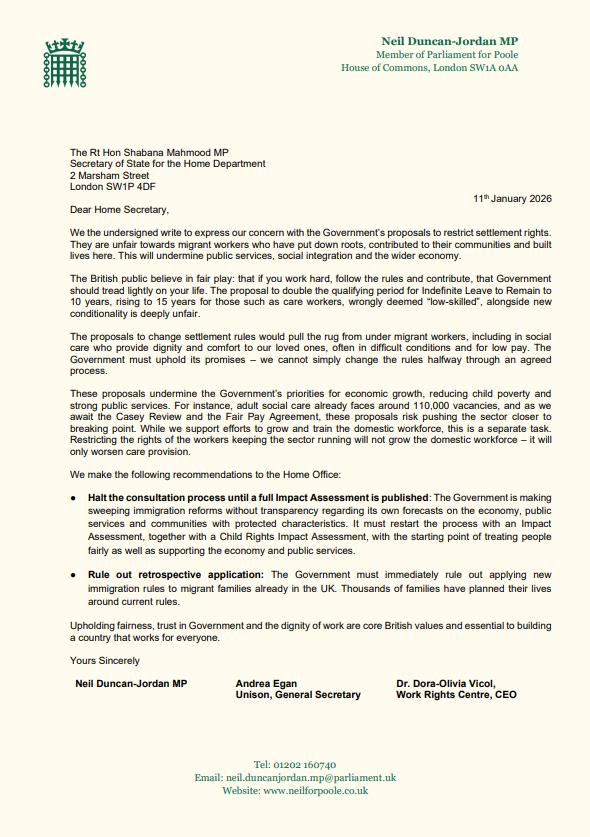
The first page of the letter to Mahmood.
[1]The new asylum regime: the first steps: https://bobmouncer.blog/2026/03/27/the-new-asylum-regime-the-first-steps/
[2] See my earlier blog for concerns expressed by others: The new asylum regime: the first steps, Concerns: The new asylum regime: the first steps « Bob Mouncer’s blog
[3]New and old hostilities: New and old hostilities « Bob Mouncer’s blog
[4] See New and old hostilities, Earn your keep: New and old hostilities « Bob Mouncer’s blog
[5] Restoring Order and Control: A statement on the government’s asylum and returns policy, Foreword from the Home Secretary, and para 2: Restoring Order and Control: A statement on the government’s asylum and returns policy (accessible) – GOV.UK
[6] The Migration Advisory Committee is a public body that advises the government on migration policy (see Migration Advisory Committee – GOV.UK).
[7] Changes to UK visa and settlement rules after the 2025 immigration white paper, House of Commons Library, 20 March 2026, section 1: Changes to UK visa and settlement rules after the 2025 immigration white paper – House of Commons Library
[8] Changes to UK visa and settlement rules after the 2025 immigration white paper, House of Commons Library, 20 March 2026, section 2: Changes to UK visa and settlement rules after the 2025 immigration white paper – House of Commons Library
[9] UK’s migration crackdown risks care home staffing crunch, 22 April 2026: UK’s migration crackdown risks care home staffing crunch | Reuters
[10] UK’s migration crackdown risks care home staffing crunch, 22 April 2026: UK’s migration crackdown risks care home staffing crunch | Reuters
[11] Cited, UK’s migration crackdown risks care home staffing crunch, 22 April 2026: UK’s migration crackdown risks care home staffing crunch | Reuters
[12] UK’s migration crackdown risks care home staffing crunch, 22 April 2026: UK’s migration crackdown risks care home staffing crunch | Reuters
[13]Cited, UK’s migration crackdown risks care home staffing crunch, 22 April 2026: UK’s migration crackdown risks care home staffing crunch | Reuters
[14] Restoring Order and Control: a statement on the government’s asylum and returns policy, 21 November 2025: Restoring Order and Control: A statement on the government’s asylum and returns policy (accessible) – GOV.UK
[15] Changes to UK visa and settlement rules after the 2025 immigration white paper, 20 March 2026: Changes to UK visa and settlement rules after the 2025 immigration white paper – House of Commons Library
[16] Explanatory memorandum to the statement of changes in the Immigration Rules:Explanatory memorandum to the statement of changes in the Immigration Rules: HC 1691, 5 March 2026 (accessible) – GOV.UK
[17] Explanatory memorandum to the statement of changes in the Immigration Rules, para. 5.67: Explanatory memorandum to the statement of changes in the Immigration Rules: HC 1691, 5 March 2026 (accessible) – GOV.UK
[18] Apply for the Global Talent Visa: Apply for the Global Talent visa : Overview – GOV.UK
[19] “Neil Duncan-Jordan MP opposes Home Office planned changes”, Bournemouth Echo: Neil Duncan-Jordan MP opposes Home Office planned changes | Bournemouth Echo
Truth is falsehood — or is it the other way round?
The Guardian says:
The fate of the two-week ceasefire in the Iran conflict looked in peril on Wednesday as both sides gave divergent versions of what had been agreed, Israel intensified its bombing campaign in Lebanon and Iran halted the passage of oil tankers because of an alleged Israeli ceasefire breach.
So if the Guardian editor asked for a summing up of the situation, just to save space, it ought to be “There is no ceasefire. Zilch! It’s over.”
That would also be more truthful. The UN human rights chief, Volker Turk, talks of “pressure on a fragile peace” after calling Israel’s attack on Lebanon “carnage”! How fragile can you get? Peace is war — or war is peace — where have I heard that before? In truth (and let’s hang on desperately to that idea before it becomes “truth is falsehood” or “falsehood is truth”), in truth, I say, there never was a ceasefire, either here or in Gaza. The war will go on in both cases until Trump is triumphant. That’s what the MAGA doubters want. They don’t want “forever wars”, they want a quick undeniable victory that will Make America Great Again. And Trump’s willingness to destroy “a whole civilisation” promises that “like never before”. Will he deliver it? Let’s hope not.
The new asylum regime: the first steps
The first steps towards the UK’s new asylum regime have now been taken. The Immigration Rules have been changed so that if you apply for asylum now and, after the Home Office has considered your application, you are recognised as a refugee, your protection will last only 30 months, after which you will have to apply to renew it. If at that point the Home Office decides that your country is safe for you to go back to, you will be sent back there.[1] If the Home Office decides that your country is still unsafe, your temporary leave will be extended for another 30 months, but you won’t be able to apply for Indefinite Leave to Remain (ILR) until you’ve been here for 10 years (previously it was five years). Under this scheme, you can apply to renew your 30-month visa four times, at a cost of £3,908.50 each time.[2] However, if you have been receiving benefits (including while in work) for up to 12 months you will have to wait 15 years before you can apply for ILR; if you have been receiving benefits for more than 12 months you will have to wait 20 years before applying for ILR.[3] Incidentally, if you are eligible to apply for ILR, the sooner you do it the better – from 8 April, the cost of an application will rise to £2,064, from the previous £1,938.[4] Maintaining the Home Office’s capacity to invent money-making schemes has been a consistent element in asylum policy for several decades.
Concerns
Critics have expressed their concerns about these changes. UNHCR commented on the original proposal to make protection temporary:
Providing refugees with only 30 months of leave at a time is likely to be detrimental to refugees’ sense of security, belonging and stability, factors critical to positive engagement and participation in society. Status of such a temporary nature may impact on a person’s ability to find housing, seek employment, learn English and develop skills, and risks undermining the Government’s intention to enhance refugees’ ability to contribute to their new communities.[5]
Mark Evans, president of the Law Society of England and Wales, gave this warning:
The rules announced today will create prolonged uncertainty for people who want to live free from danger and have been recognised by the government as needing protection. The changes stand in tension with Article 34 of the Refugee Convention, under which the UK has agreed to facilitate as far as possible the assimilation and naturalisation of refugees.[6]
Sophie McCann of Médecins sans Frontières, said:
Embedding prolonged uncertainty and fear within the asylum system will create further psychological harm and inhibit refugees’ – including our patients’ – ability to heal from their experiences and rebuild their lives with dignity.[7]
Nothing new under the sun?[8]
In one sense, these changes, and the rhetoric behind them, are part of a long-standing, and increasing, unwillingness of UK governments to accept refugees. In 1995, Tory Home Secretary Michael Howard declared that asylum applications were rising in the UK and falling in the rest of Europe because the UK gave easy access to jobs and benefits, claiming that “only a tiny proportion of them are genuine refugees”. Social Security Secretary Peter Lilley claimed that “genuine political refugees are few” and that Britain was “a soft touch”.[9] In 2002, Labour Home Secretary David Blunkett suggested that asylum-seeking children should be educated separately from other pupils so that they weren’t “swamping the local school”. Labour MP Diane Abbott responded, “For goodness’ sake, we’re talking about children here, not raw sewage!”[10] In 2003, Prime Minister Tony Blair’s chief of staff Jonathan Powell proposed withdrawing from Article 3 of the European Convention on Human Rights (ECHR) – which prohibits torture and inhuman or degrading treatment – so that more asylum seekers could then be deported back to their home countries.[11] Blair scribbled in the margin of one document that raised doubts about the legality of such a policy: “Just return them. This is precisely the point. We must not allow the ECHR to stop us dealing with it.”[12] Lord Irvine, the Lord Chancellor, gave such proposals short shrift, telling Blair and Home Secretary David Blunkett, with much irony, “I don’t know why you guys don’t just adopt the Zimbabwean constitution and have done with it.” Finally, the Attorney-General, Lord Goldsmith, told them that any attempt by the UK to avoid its responsibilities under the European Convention would put the UK in breach of its EU membership obligations.[13] The policy was not adopted. The current Labour government is lobbying in the European Commission for changes to the ECHR, but has not so far tampered with it. Indeed, in its Explanatory Memorandum justifying Mahmood’s new asylum policy, the Home Office carefully explains that the new regime “aims to provide entitlements for refugees that are entirely in accordance with our international obligations but do not exceed them” (my italics).[14] But the unashamed cruelty of Mahmood’s policies, and the deep hostility to asylum seekers she openly displays in her rhetoric, are unprecedented. We would be foolish to imagine that ECHR safeguards are safe in this government’s hands.
Visa brake
The government is refusing all study visas for people from Afghanistan, Myanmar, Sudan and Cameroon. It will also deny Afghans another visa: “Additionally,” says Mahmood, “we will refuse Skilled Worker visa applications from main applicants who are nationals of Afghanistan.”[15] The visa brake “will come into effect from 26 March but will not affect applications made before 26 March” – which is one bit of good news at least. Mahmood claims that the visa brake is “not intended to be permanent and will be regularly reviewed, with the aim that it can be released as soon as it is considered appropriate to do so”. We shouldn’t expect that promise to be fulfilled any time soon.
So what is the reason for applying the “visa brake”? It’s the usual one: asylum seekers are “taking advantage” of us. The Home Office says that high numbers of asylum claims are made by people from these countries after they have finished their study periods in the UK – and the Home Office sees this as abuse: “The government is clamping down on visa abuse so the UK can maintain its ability and proud tradition of helping those genuinely in need.” Mahmood, in typically strident mode, said she was “taking the unprecedented decision to refuse visas for those nationals seeking to exploit our generosity. I will restore order and control to our borders.”[16] There is, however, conflict, war and human rights abuse in all four of these countries: the Taliban are still the government in Afghanistan and the security situation is volatile. Moreover there have been increased tensions between Afghanistan and Pakistan, with violent clashes on the border. In Sudan there has been civil war since 2023, during which millions have fled their homes. The United Nations (UN) has called this the world’s largest humanitarian crisis. There is unrest in Cameroon, where militia are fighting for the independence of the country’s two English-speaking regions in what is mainly a French-speaking nation. There has been civil war in Myanmar since 2021, following a military coup.[17]
So “abuse” and “exploit” may not be the most appropriate words to describe the actions of students and skilled workers from those countries who need safe routes to protection. (You will notice there is no question of the government listening to their asylum claims, which is an obligation under the Refugee Convention. There is just a total ban on the visas. And if anyone from these four countries, in desperation, dares to arrive in a small boat, don’t worry – we’ve already declared that to be “illegal”.[18])
Nevertheless, there is a chance that the visa brake will put the Home Office in more trouble than it expected. Five students from Sudan and one from Afghanistan, with undergraduate degrees in medicine and other science-based subjects, have written an open letter to the Home Secretary saying that the decision to deny visas to students from only four countries is not only unlawful and irrational but also a violation of their human rights. They have launched legal action against the government.[19] Maybe others will join them. It is always possible to resist.
[1] For the notorious, and disastrous, record of governments in assessing whether a country is “safe”, see Mouncer, Bob (2009), Dealt with on their Merits? The Treatment of Asylum Seekers in the UK and France, University of Hull, Kingston-upon-Hull, paras 6.5.3-6.5.9: https://acrobat.adobe.com/id/urn:aaid:sc:EU:ecdd073f-c9b1-4905-859b-33bd62c23f47 For more recent inspections of the Home Office’s use of country reports, see An Inspection of the Production and use of Country of Origin Information, Independent Chief Inspector of Borders and Immigration, Chapter 6, January 2018: An_inspection_of_the_production_and_use_of_Country_of_Origin_Information.pdf
[2] “UK migrant families face giving up vital in-work benefits to avoid being ‘punished’, The Guardian, 20/2/2026: UK migrant families face giving up vital in-work benefits to avoid being ‘punished’ | Benefits | The Guardian
[3] “Some migrants to face 20 year wait for settled status”, BBC News, Some migrants to face 20-year wait for settled status – BBC News
[4] “Emergency Brake” Visa Pushback, Key Asylum Changes and More – UK March 2026 Updates, Immigration Advice Service: Emergency Visa Brakes, Asylum and More – March 2026 Updates
[5] UNHCR Observations on UK Asylum Statement “Restoring Order and Control”, UNHCR, 31 December 2025, para 5.9: UNHCR Observations On UK Asylum Statement ‘Restoring Order and Control’ | UNHCR UK
[6] Article 34 reads: “The contracting states shall as far as possible facilitate the assimilation and naturalisation of refugees. They shall in particular make every effort to expedite naturalisation proceedings and to reduce as far as possible the charges and costs of such proceedings.”
(“Mahmood’s move to make asylum temporary ‘may undermine refugee convention’”, The Guardian, 2 March 2026: Mahmood’s move to make asylum temporary ‘may undermine refugee convention’ | Refugees | The Guardian)
[7] “Mahmood’s move to make asylum temporary ‘may undermine refugee convention’”, The Guardian, 2 March 2026: Mahmood’s move to make asylum temporary ‘may undermine refugee convention’ | Refugees | The Guardian
[8] The biblical book of Ecclesiastes, chapter 1, verse 9: “What has been is what will be, and what has been done is what will be done; and there is nothing new under the sun.”
[9] Mouncer, Bob (2009). Dealt with on their Merits? The Treatment of Asylum Seekers in the UK and France, University of Hull, Kingston-upon-Hull, pp. 96-97: https://acrobat.adobe.com/id/urn:aaid:sc:EU:ecdd073f-c9b1-4905-859b-33bd62c23f47
[10] “Row erupts over Blunkett’s ‘swamped’ comment”, The Guardian, 24 April 2002: Row erupts over Blunkett’s ‘swamped’ comment | Politics | The Guardian
[11] Nicholas Watt & Patrick Wintour, “How immigration came to haunt Labour: the inside story”, The Guardian, 24 March 2015: How immigration came to haunt Labour: the inside story | Immigration and asylum | The Guardian
[12] “Tony Blair considered sending asylum seekers to a camp on the Isle of Mull, documents reveal”, the Independent, 29 December 2023: Tony Blair considered sending asylum seekers to a camp on the Isle of Mull, documents reveal | The Independent
[13] Nicholas Watt & Patrick Wintour, “How immigration came to haunt Labour: the inside story”, The Guardian, 24 March 2015: How immigration came to haunt Labour: the inside story | Immigration and asylum | The Guardian
[14] Explanatory memorandum to the statement of changes in the Immigration Rules, section 2.25, para. 5.7: Explanatory memorandum to the statement of changes in the Immigration Rules: HC 1691, 5 March 2026 (accessible) – GOV.UK
[15]Explanatory memorandum to the statement of changes in the Immigration Rules, section 2.25, para. 5.3: Explanatory memorandum to the statement of changes in the Immigration Rules: HC 1691, 5 March 2026 (accessible) – GOV.UK
[16]“Mahmood to stop study visas from four countries due to ‘abuse’” BBC News, 3 March 2026: Mahmood to stop study visas from four countries due to ‘abuse’ – BBC News
[17] “Mahmood to stop study visas from four countries due to ‘abuse’”, BBC News, 3 March 2026: Mahmood to stop study visas from four countries due to ‘abuse’ – BBC News
[18] See my earlier blog, New and Old Hostilities: New and old hostilities « Bob Mouncer’s blog
[19] “Six students challenge Home Office visa ban on four countries”, The Guardian, 23/3/2026: Six students challenge Home Office visa ban on four countries | Immigration and asylum | The Guardian
How a poem was composed in a time of war
It’s 1917, towards the end of the First World War. The poet and soldier Siegfried Sassoon has made his Declaration against the war:
I am making this statement as an act of wilful defiance of military authority, because I believe the war is being deliberately prolonged by those who have the power to end it. I am a soldier, convinced that I am acting on behalf of soldiers. I believe that this war, upon which I entered as a war of defence and liberation, has now become a war of aggression and conquest. I believe that the purposes for which I and my fellow soldiers entered upon this war should have been so clearly stated as to have made it impossible to change them, and that, had this been done, the objects which actuated us would now be attainable by negotiation. I have seen and endured the suffering of the troops, and I can no longer be a party to prolong these sufferings for ends which I believe to be evil and unjust. I am not protesting against the conduct of the war, but against the political errors and insincerities for which the fighting men are being sacrificed. On behalf of those who are suffering now I make this protest against the deception which is being practised on them; also I believe that I may help to destroy the callous complacence with which the majority of those at home regard the continuance of agonies which they do not share, and which they have not sufficient imagination to realize.
S. Sassoon
In Craiglochart hospital, where Siegfried Sassoon was sent after making this Declaration, he and fellow inmate Wilfred Owen are discussing a draft of Owen’s latest poem.
Sassoon took the sheet and read the whole poem through twice, then returned to the first two lines. “What minute-bells for these who die so fast? – Only the monstrous/solemn anger of our guns.”
Owen: “I thought ‘passing’ bells.”
Sassoon: “Hm. Though if you lose ‘minute’ you realize how weak ‘fast’ is. ‘Only the monstrous anger …’ “
Owen: “‘Solemn’?”
Sassoon: “‘Only the solemn anger of our guns.’ Owen, for God’s sake, this is War Office propaganda.”
Owen: “No, it’s not.”
Sassoon: “Read that line.”
Owen: “Well, it certainly isn’t meant to be.”
Sassoon: “I suppose what you’ve got to decide is who are ‘these’? The British dead? Because if they’re British, then ‘our guns’ is …”
Owen shook his head. “All the dead.”
Sassoon: “Let’s start there.” Sassoon crossed out “our” and pencilled in “the”. “You’re sure that’s what you want? It isn’t a minor change.”
Owen: “No, I know. If it’s ‘the’, it’s got to be ‘monstrous’.”
Sassoon: “Agreed.” Sassoon crossed out “solemn”. “So: ‘What passing-bells for these who die …’ so fast? ‘– Only the monstrous anger of the guns.'”
Owen: “Well, there’s nothing wrong with the second line.”
Sassoon: “‘In herds’?”
Owen: “Better.”
A few days later:
Sassoon: “What draft is this?”
Owen: “Lost count. You did tell me to sweat my guts out.”
Sassoon: “Did I really? What an inelegant expression. ‘What passing-bells for these who die as cattle?’ I see we got to the slaughterhouse in the end.”
Sassoon read through the poem. When he’d finished, he didn’t immediately comment.
Owen: “It’s better, isn’t it?”
Sassoon: “Better? It’s transformed.” He read it again. “Though when you look at the sense … You do realize you’ve completely contradicted yourself, don’t you? You start by saying there is no consolation, and then you say there is.”
Owen: “Not consolation. Pride in the sacrifice.”
Sassoon: “Isn’t that consolation?”
Owen: “If it is, it’s justifiable. There’s a point beyond which –”
Sassoon: “I don’t see that.”
Owen: “There’s a point beyond which you can’t press the meaninglessness. Even if the courage is being abused, it’s still …” Owen leapt up, went to the drawer of his washstand and produced the typescript Sassoon had lent him. He began leafing quickly but carefully through it. Sassoon, watching, thought, he’s getting better. No stammer. Quick, decisive movements. The self-confidence to contradict his hero. And the poem had been a revelation.
Owen: “Look, you do exactly the same thing:
O my brave brown companions, when your souls
Flock silently away, and the eyeless dead
Shame the wild beast of battle on the ridge,
Death will stand grieving in that field of war
Since your unvanquished hardihood is spent.
And through some mooned Valhalla there will pass
Battalions and battalions, scarred from hell;
The unreturning army that was youth;
The legions who have suffered and are dust
“What’s that if not pride in the sacrifice?”
Sassoon: “Grief? All right, point taken. I just don’t like the idea of … making it out to be less of a horror than it really is.” He looked down at the page. “I think you should publish this.”
Owen: “You mean in the Hydra?”
Sassoon: “No, I mean in the Nation. Give me a fair copy and I’ll see what I can do. You’ll need a different title, though. ‘Anthem for …'” He thought for a moment, crossed one word out, substituted another. “There you are.” He handed the page back, smiling. “’Anthem for Doomed Youth’.”
The completed poem:
What passing-bells for these who die as cattle?
–Only the monstrous anger of the guns.
Only the stuttering rifles’ rapid rattle
Can patter out their hasty orisons
No mockeries now for them; no prayers nor bells;
\nor any voice of mourning save the choirs, —
The shrill, demented choirs of wailing shells;
And bugles calling for the from sad shires.
What candles may be held to speed them all?
Not in the hands of boys but in their eyes
Shall shine the holy glimmers of goodbyes.
The palor of girls’ brows shall be their pall;
Their flowers the tenderness of patient minds,
And each slow dusk a drawing-down of blinds.
Owen was killed in action several days before the Armistice ended the war. Sassoon was wounded in 1918 and spent what was left of the war in London. He died in 1967.
Conversation between Sassoon and Owen adapted from Pat Barker (1992), Regeneration, Penguin Books, London, pp. 141-142, 156-158.
“God bless us, everyone” — or kind of …
First, an interesting and welcome headline in The Guardian:
“C of E to challenge Tommy Robinson’s ‘put Christ back into Christmas’ message”
The C of E is, of course, the Church of England. The state church, whose bishops sit in the House of Lords. King Charles II is the Church’s head.
There will be a poster campaign:
The posters, which will go on display at bus stops, say “Christ has always been in Christmas” and “Outsiders welcome”. They will also be available for local churches to download and display over the festive period.
The Guardian continues:
“The C of E’s decision to challenge Robinson’s extreme rightwing stance comes amid growing unease among church leaders about the rise of Christian nationalism and the appropriation of Christian symbols to bolster the views of his supporters.”
Not a moment too soon. If Farage becomes prime minister in 2029, the C of E will have little room to manoeuvre and will have to speak and do as it’s told, on pain of disestablishment. It’d be a pity for it to lose all that pomp and privilege. Let’s hope the latest move is not too late.
I see some of the other churches are joining in:
“The Joint Public Issues Team, a partnership between the Baptist Union of Great Britain, the Methodist church and the United Reformed church is offering a ‘rapid response resource’ for local churches trying to ‘navigate the complexities’ of Christian nationalism and the ‘co-option of Christian language and symbols – including Christmas – for a nationalist agenda’.”
Of course, the C of E is itself an expression of “Christian nationalism”, what with the king being its head and all that. Now there’s a complexity to navigate if ever there was one. At least the others, all those Baptists, United Reformists, Methodists and random Pentecostals, don’t have that hanging round their necks. And I wish them luck (even the C of E). I’m on their side.
Amen, in fact.
Progressively taking soundings
The Guardian this morning says:
“Keir Starmer to launch progressive fightback against ‘decline and division’ fuelled by far right”
I can see the OED having to reassess its definition of the word “progressive” soon. More work for them — they’re already busy modifying “change”.
Anyway,
“Senior sources said Starmer had begun to spend significantly more time taking soundings from MPs … As well as spending time last week in the voting lobbies and tea rooms with MPs, Starmer hosted a delegation for breakfast in No 10 on Monday morning.”
I get why he would go to the tea rooms — taking soundings is thirsty work. And there’s no substitute for a traditional (English) breakfast to get you off on the right foot. But the lobbies? I thought you just went there to vote. Unless this is a bullying operation: “No, Richard, you’re in the wrong lobby. You want the progressive lobby.” It’ll get Keir nowhere though. Richard Burgon, the honourable member for Leeds East, knows the meaning of “honourable ”.
More work for the OED, though. On the definition of “taking soundings”!
No change
So I woke up this morning, noting a slight chill in the air. But nothing spectacular, either weatherwise or any other wise. There certainly doesn’t seem to be any change in the political scene at all.
Yet there is a flurry of headlines that think the opposite, and the BBC spells it out clearly: “Sir Keir Starmer is expected to announce the UK’s recognition of a Palestinian state in a statement on Sunday afternoon.”
There are two main problems with this. One is that there is no Palestinian state waiting to be recognised. The other is that UK policy has long been to support a two-state solution. This would necessarily involve recognition. So, as of this slightly chilly “Sunday afternoon”, nothing will have changed. Yet we are to believe that brave Keir has looked at the situation over the last few weeks and, calling into play the courage for which he is justly famed, has “shifted” his policy in defiance of Trump. Bravo! But it’s all bullshit.
In any case, Netanyahu, backed by Trump, won’t be making way for a Palestinian state. There will be no Palestinians left in the West Bank or Gaza, when Bibi and Trump have done their worst; and let’s not forget that Gaza itself is set to be the new Riviera, set up for rich people who have become bored with Nice, Cannes and Monte Carlo, with their nice clean beaches. The new, Trump-owned beaches of Gaza won’t just be clean: they’ll have been cleansed.
What more could you want?
Labour, immigration and Enoch Powell
Introduction
In an earlier blog, we saw how working parties were set up after the Second World War whose task was to justify racist immigration controls.[1] They repeatedly failed to do so, but they continued their efforts for 17 years. Finally, employing a series of manifestly false arguments, the Tories passed the Commonwealth Immigrants Act 1962, complete with racist controls.
Hostility to black Commonwealth immigrants, however, was not confined to the Tories. It was, after all, the Labour government elected in 1945 that set up the working parties in the first place. Kieran Connell writes of “the relentless presence of racism in 1940s Britain, and the related influence of ideas about race.”[2] Labour was part of that pressure and influence. In 1946, Labour Home Secretary Chuter Ede told a cabinet committee that when it came to immigration he would be much happier if it “could be limited to entrants from the Western countries, whose traditions and social backgrounds were more nearly equal to our own.”[3] When the Empire Windrush arrived in 1948 with 492 Jamaicans ready to work to rebuild post-war Britain, 11 Labour MPs wrote to Prime Minister Clement Attlee, notifying him of “the fact that several hundred West Indians have arrived in this country trusting that our government will provide them with food, shelter and employment.” They feared that “their success might encourage other British subjects to follow their example.” This would turn Britain into
an open reception centre for immigration not selected in relation to health, education and training and above all regardless of whether assimilation was possible or not … An influx of coloured people domiciled here is likely to impair the harmony, strength and cohesion of our public and social life and cause discord and unhappiness among all concerned.[4]
Attlee replied to the letter, reassuring them that “if our policy [of unrestricted immigration] were to result in a great influx of undesirables we might, however unwillingly, have to consider modifying it.”[5] Kenan Malik notes that this exchange of letters contains many assumptions that shaped official and popular attitudes to post-war black immigration:
There are two kinds of British citizens: white people and “undesirables”. Britain is in danger of being swamped by immigrants taking advantage of the nation’s generosity. Immigrants’ standards of “health, education and training” are lower than those of British people. Black people are incapable of assimilating British culture. A large black presence in Britain would create social tensions.[6]
Such attitudes didn’t end with that decade but continued through the 17 years to 1962. At first, therefore, it seems puzzling that Labour opposed the 1962 Act throughout its passage through parliament. It did so, however, in the context of the ending of British rule in countries that were previously part of the British Empire and were now becoming independent nations. Britain’s post-war determination to justify immigration controls against black immigrants now came up against its need to build Commonwealth institutions and keep a political and economic foothold in the countries it once ruled. To that end, the Commonwealth was increasingly promoted as a “family of nations”. Any suggestion that the racism that had served British interests “out there” in the old Empire might now be applied to citizens of the new Commonwealth when they came here could threaten the whole project. This was a dilemma for both the main political parties. Lord Salisbury (Lord President of the Council and Tory Leader of the House of Lords) was a strong advocate of immigration controls. When a working party reported that there was no evidence that black immigrants were more inclined to criminality than white natives, he roundly declared in 1954: “It is not for me merely a question of whether criminal negroes should be allowed in … it is a question of whether great quantities of negroes, criminal or not, should be allowed to come.”[7] Lord Swinton (Secretary of State for Commonwealth Relations) agreed but warned Salisbury of the dangers ahead: “If we legislate on immigration, though we can draft it in non-discriminatory terms, we cannot conceal the obvious fact that the object is to keep out coloured people.”[8] Other Tories were more cautious. Henry Hopkinson, Minister of State at the Colonial Office, declared: “We still take pride in the fact that a man can say civis Britannicus sum [I am a British citizen] whatever his colour may be and we take pride in the fact that he wants to and can come to the mother country.”[9] In 1958, Arthur Bottomley, on Labour’s front bench, had also spoken up for the new Commonwealth and against immigration controls:
The central principle on which our status in the Commonwealth is largely dependent is the “open door” to all Commonwealth citizens. If we believe in the importance of our great Commonwealth, we should do nothing in the slightest degree to undermine that principle.[10]
It seemed for a while as if the battle between racist immigration controls, espoused by both parties, and the Commonwealth ideal of a “family of nations”, also espoused by both parties, might be won by the Commonwealth. But when Labour won the 1964 general election, the new government immediately refocused on immigration controls and increased the restrictions in the 1962 Act. In the years to come, Labour would introduce legislation and rules to reduce black immigration whenever it got the chance.
Facing both ways
Labour in government dealt with the embarrassing contradiction between racism and the “Commonwealth ideal” by facing both ways and hoping nobody would notice. It constantly sought to reassure voters that it “understood” their “genuine concerns” about immigration and enacted increasingly restrictive immigration laws. At the same time, it denied being racist and passed legislation aimed at creating “good race relations”. What often emerged from this process, however, were weak race-relations laws, suggesting that the government’s priority was to curb immigration. Thus, the Race Relations Acts of 1965 and 1968 were half-hearted affairs. While the 1965 Act did prohibit “incitement to racial hatred”, when it came to discrimination it didn’t include discrimination in housing and employment, and it didn’t apply to the police; and while the 1968 Act went further and included discrimination in housing and employment, the government decided that this would not apply to the police, who had exerted strong pressure on the cabinet not to include them. Home Secretary James Callaghan told the cabinet at the time:
The opposition of the Police Federation to amending the [police disciplinary] code has been intense and deep-seated. And the Police Advisory Board has been unanimous in advising me not to proceed.[11]
In 1968, the government introduced a new Commonwealth Immigrants Act which seemed set to undo the limited good the two Race Relations Acts had done. The Act refused all Commonwealth immigrants entry into the UK unless they could prove they were – or one of their parents or grandparents was – born, naturalised or adopted in the UK, or unless they were otherwise registered in specified circumstances as UK citizens.[12] This meant that citizens in the “white” Commonwealth (Canada, Australia, New Zealand) were not refused entry. The Act was Labour’s response to the Kenyan Asians crisis, when racism on the far right of the Tory Party was at its most virulent and dangerous. It was a decision to follow the Tory racists.
The Kenyan Asians: race, nation and the end of Empire
The Kenyan Asians were being forced out of Kenya by its government’s Africanisation policy, which excluded Kenya’s Asian population from employment and other rights. Many of them had British passports, which a British Conservative government had allowed them to retain following Kenya’s independence in 1963. Now, not surprisingly, they expected to be able to use them. The Labour government, however, decided otherwise. 80,000 of them, out of a total of about 200,000, had arrived in Britain by early 1968 and the government had been under pressure from several directions to keep them out. A campaign against allowing them to enter the country was launched by Tory MPs Duncan Sandys and Enoch Powell. Sandys had already told the Conservative Party Conference in 1967:
We are determined to preserve the British character of Britain. We welcome other races, in reasonable numbers. But we have already admitted more than we can absorb.[13]
Now Powell set about raising the temperature: he used deliberately provocative and racist language. He claimed a woman had written to him (anonymously, Powell alleged, out of fear of reprisals if her identity became known) claiming abuse by “Negroes”. She had, according to Powell’s story, paid off her mortgage and had started to let some of the rooms in her house to tenants; but she wouldn’t let to “Negroes”:
Then the immigrants moved in [to the neighbourhood]. With growing fear, she saw one house after another taken over. The quiet street became a place of noise and confusion. Regretfully, her white tenants moved out … She finds excreta pushed through her letter box. When she goes to the shops, she is followed by children, charming, wide-grinning piccaninnies.”[14]
Powell declared:
Those whom the gods wish to destroy, they first make mad. We must be mad, literally mad, as a nation to be permitting the annual inflow of some 50,000 dependants, who are for the most part the material of the future growth of the immigrant-descended population. It is like watching a nation busily engaged in heaping up its own funeral pyre.[15]
The British Empire, which Powell had supported, was no more. Its former subjects had fought for, and won, their independence. Satnam Virdee argues that, for Powell,
Black and Asian workers had now become the unintended reminder of peoples abroad who wanted nothing to do with the British Empire. And, in the mind of Powell, this invited the question, “What are they doing here in Britain?”[16]
For Powell, they “represented the living embodiment of the Empire that now was lost, a painful and daily reminder of [Britain’s] defeat on the world stage.”[17] For that reason, as well as his nightmare that the “immigrant-descended population” would lead to a “funeral pyre”, he was in favour of their repatriation (or, as he put it, their “re-emigration”) to the countries they or their parents had come from:
I turn to re-emigration. If all immigration ended tomorrow, the rate of growth of the immigrant and immigrant-descended population would be substantially reduced, but the prospective size of this element in the population would still leave the basic character of the national danger unaffected.[18]
The way to solve this problem was through “the encouragement of re-emigration”. Powell noted that no such policy had been tried, so there was no evidence from which to judge potential success or failure: “Nobody knows,” he said. So he once again called his constituents in aid to support him:
I can only say that, even at present, immigrants in my own constituency from time to time come to me, asking if I can find them assistance to return home. If such a policy were adopted and pursued with the determination which the gravity of the alternative justifies, the resultant outflow could appreciably alter the prospects.[19]
The leader of the Tory opposition, Edward Heath, sacked Powell from the shadow cabinet after the speech. But there were demonstrations in support of Powell in the immediate aftermath of the speech and his sacking. There were strikes by thousands of workers. They began in the West Midlands, where Powell’s constituency was located. Construction workers and power workers struck in Wolverhampton and Birmingham, there were strikes in Coventry and Gateshead. Then they spread to the London docks and the meat porters of Smithfield market. Strikers marched “from the East End to Westminster carrying placards reading ‘Don’t knock Enoch’ and ‘Back Britain, not Black Britain’.”[20]
But Powell remained sacked. His intervention was not welcomed by mainstream politicians in the Tory party, Labour or the Liberal Party. For one thing, his provocative racism seemed likely to threaten Britain’s social stability if unchecked. Moreover, good relations with the independent countries of the Commonwealth were still deemed vital to British interests: Powell’s racism not only threatened stability at home, it endangered good and profitable relations abroad. Nevertheless, there were some in official circles who seemed to believe that government promises to its citizens could be broken with impunity. Eric Norris, the British High Commissioner in Nairobi, was against allowing the Kenyan Asians in and he watched them as they queued outside his office demanding that the British government keep its promises and honour its commitments: “They all had a touching faith”, he later said scornfully, “that we’d honour the passports that they’d got.”[21] There had been still other pressures on the government: the far-right National Front – whose preoccupations were, like Powell’s, with white British identity and the repatriation of black and Asian immigrants – were stirring in the same pot. But the government could have resisted these pressures. The liberal press, churches, students and others opposed the campaign against the Kenyan Asians and could have been called in aid. Instead, it joined the Tory racists. Home Secretary James Callaghan wrote a memo to the cabinet:
We must bear in mind that the problem is potentially much wider than East Africa. There are another one and a quarter million people not subject to our immigration control … At some future time we may be faced with an influx from Aden or Malaysia.[22]
The Act was passed in 72 hours. It met Callaghan’s wider fears, and it rendered the Kenyan Asians’ passports worthless. No wonder that a year later The Economist declared that Labour had “pinched the Tories’ white trousers”.[23]
[1] By Hook or by Crook – Determined to be Hostile: https://bobmouncer.blog/2025/05/04/__trashed-2/
[2] Connell, Kieran (2024), Multicultural Britain: A People’s History, C. Hurst & Co. (Publishers) Ltd., London, p. 46.
[3] Cited, ibid., p. 20.
[4] Cited, Malik, Kenan (1996), The Meaning of Race: Race, History and Culture in Western Society, Macmillan, Basingstoke, p. 19.
[5] Cited, ibid.
[6] Ibid.
[7] Carter, B., Harris, C. & Joshi, S. (1993), “The 1951-55 Conservative Government and the Racialization of Black Immigration”, in James, W. & Harris, C. (eds), Inside Babylon: the Caribbean Diaspora in Britain, Verso, London, p. 65.
[8] Spencer, I. (1997), British Immigration Policy since 1939: the Making of Multi-Racial Britain, Routledge, London, p. 64.
[9] Hayter, T. (2000), Open Borders: the Case against Immigration Controls, Pluto Press, London, p. 44.
[10] Foot, P. (1968), The Politics of Harold Wilson, Penguin Books, Harmondsworth, p. 251.
[11] “Callaghan: I was wrong on police and race”, BBC News, 8 January 1999: BBC NEWS | Special Report | 1999 | 01/99 | 1968 Secret History | Callaghan: I was wrong on police and race
[12] Commonwealth Immigrants Act 1968, s. 1 (2A).
[13] Playing the Race Card, 24 October 1999, Channel Four Television, London.
[14] Palash Ghosh, ”Enoch Powell’s ’Rivers of Blood‘ Speech”, International Business Times, 14/6/2011: Enoch Powell’s “Rivers of Blood” Speech (FULL-TEXT) | IBTimes
[15] Ibid.
[16] Virdee, S. & McGeever, B. (2023). Britain in Fragments: Why things are falling apart, Manchester University Press, Manchester, p. 71.
[17] Ghosh, op cit.
[18] Ibid.
[19] Ibid.
[20] Virdee, S. & McGeever, B. (2023). Britain in Fragments: Why things are falling apart, Manchester University Press, Manchester, pp., 72-74.
[21] Playing the Race Card, 24 October 1999, Channel Four Television, London.
[22] Cited, Hayter, T. (2000), Open Borders: the case against immigration controls, Pluto Press, London, p. 53.
[23] Cited, ibid., p. 51.
By hook or by crook — determined to be hostile
Introduction
In recent blogs, I examined the hostile environment policy introduced by UK Home Secretary Theresa May during the early 2010s and the political scandals and human tragedies that followed: the Windrush and Mediterranean scandals.[1] Although at first sight the hostile environment policy seemed to be the creation of Conservative (Tory) governments, first under David Cameron and then under Theresa May, a closer examination raised questions about the policies on immigration and race adopted by all the main political parties over a much longer period. I will show, in particular, that both Tory and Labour governments have long been enthusiasts for racist immigration controls. I begin in 1945 and the need for reconstruction of the country after the destruction wreaked during the Second World War. In doing so, I will need to destroy a myth that has comforted most of us for many years. It is the myth that a universal welcome was given by governments of the UK and its people to the mainly Caribbean immigrants who came to help reconstruct the country after the war. The reality, however, was different and more complex. Acknowledging this reality will be essential if we are to understand the decades that followed.
Reconstruction
The task of reconstruction in the UK after the Second World War was massive and daunting: many workers had been killed in the fighting and much of the country’s infrastructure and industry had been destroyed in the bombing. Workers were certainly needed and the government tried, first, to persuade workers at home to relocate to different parts of the country where the need was greatest. This had limited success, as did the government’s attempts to recruit workers from the devastated European continent. There was, however, a third source of labour that could be tapped: for at least a century no official distinction had been made between citizens of the British Empire when it came to their right to enter and live in Britain. However, contrary to the myth still propagated and almost universally accepted today, the post-war Labour government was reluctant to use this source if it meant recruiting non-white people from the Caribbean, Africa and the Indian subcontinent. Indeed, although many workers had been recruited urgently from those regions while the war was raging, the government’s intention now was to return them to their home countries. As early as April 1945, a Colonial Office official, referring to around a thousand Caribbean workers in Merseyside and Lancashire, wrote that, because they were British, “we cannot force them to return”, but it would be “undesirable” to encourage them to stay.[2] But by the middle of 1947, the government had managed to deport most of them by administrative means and, when it came to discouraging new migrants, one highly questionable means used was the distribution in the Caribbean of an official film that showed
the very worst aspects of life in Britain in deep mid-winter. Immigrants were portrayed as likely to be without work and comfortable accommodation against a background of weather that must have been filmed during the appallingly cold winter of 1947-8.[3]
At the same time, however, the government was busy trying to recruit Poles in camps throughout the UK, displaced persons in Germany, Austria and Italy, people from the Baltic states and the unemployed of Europe. Anybody was more welcome than the Caribbean workers.
But there were pressures which made this position increasingly uncomfortable for the government: it became increasingly clear after the war that the British Empire was coming to an end and Britain began to seek good political and economic relations with the newly independent former colonies, most of which were becoming part of the new British Commonwealth. The government sought to reassure Commonwealth leaders of its goodwill by maintaining the status quo on immigration: the British Nationality Act 1948 confirmed the already-existing right of Commonwealth citizens to come to the “mother country” to live and work. Behind the scenes, however, the government was still determined to travel in the opposite direction.
Working parties
In 1947, the governors of Barbados, Jamaica, Trinidad and British Guiana, countries which had high unemployment rates, tried to persuade the British government that allowing some of their workers into Britain would be beneficial both to them and to Britain. In 1948, the Colonial Office responded by setting up an interdepartmental working party, the first of many set up during these years: the “Working Party on the Employment in the UK of Surplus Colonial Labour”. Its first task was to determine whether there was a prima facie case for using colonial workers to help in reconstructing the country. The working party seemed willing to take the broad hint being offered: it concluded that there was no overall shortage of labour in the UK after all and that the only sector of the economy that might benefit from colonial labour was the health sector.[4] The government, however, remained worried.
In 1953, a confidential meeting of ministers at the Colonial Office agreed that, before legislation to restrict immigration could be introduced, empirical evidence would be needed to justify it. Police surveillance of black communities was used for this purpose and surveys were undertaken by a wide range of government departments and voluntary organisations.[5] A working party on “The Employment of Coloured People in the United Kingdom” was set up. It studied the information provided to it by the government and produced a report in 1954. The cabinet was disappointed. After considering issues related to the number of immigrants in the country, employment and unemployment, housing and criminality, it failed to provide evidence to justify legislation. For some cabinet ministers, the working party had totally missed the point. Lord Salisbury declared that the working party did not seem to recognise “the dangers of the increasing immigration of coloured people into this country.”[6] He later spelt out his views even more clearly, declaring that “for me it is not merely a question of whether criminal negroes should be allowed in; it is a question of whether great quantities of negroes, criminal or not, should be allowed to come.”[7]
Many similar working parties and departmental and interdepartmental committees were set up in this post-war period, many of them overlapping in the tasks they were set. There was the “Interdepartmental Committee on colonial people in the United Kingdom”, based in the Home Office; the “Cabinet Committee on colonial immigrants”; and the one that seemed to express its discriminatory intentions most clearly in its title: the “Interdepartmental Working Party on the Social and Economic Problems Arising from the Growing Influx into the United Kingdom of Coloured Workers from Other Commonwealth Countries”. Nevertheless, none of these committees and working parties managed to produce convincing evidence to justify legislation. On the latter committee’s reports between 1959 and 1961, Spencer writes:
Viewed objectively, the reports of the Working Party consistently failed to fulfil the purpose defined in its title …. In the areas of public order, crime, employment and health there was little noteworthy to report to their political masters.[8]
Moreover, there was uncertainty within government circles about whether there was sufficient public support for immigration controls. In November 1954, Lord Swinton, the Colonial Secretary, wrote a memorandum expressing the hope that “responsible public opinion is moving in the direction of favouring immigration control”. There was, however, “a good deal to be done before it is more solidly in favour of it”.[9] In June 1955, Cabinet Secretary Sir Norman Brook wrote to Prime Minister Anthony Eden expressing the view that, while controls were obviously necessary, the government needed “to enlist a sufficient body of public support for the legislation that would be needed”.[10] So Caribbean workers continued to arrive. Indeed, since 1949, the new National Health Service (NHS) had begun recruiting nurses from the Caribbean. In 1956, London Transport began recruiting Caribbean staff. They came because they were needed. They came because they could. But trouble was brewing which might, in the end, give Eden and Brook what they wanted.
Smoke and mirrors – mission accomplished
The trouble had its roots in the new post-war world order and Britain’s position in it as a declining colonial power. As we have seen, the British were having to face the end of their Empire as one by one its old colonies achieved independence. For supporters of the British Empire, the saddest loss was India – over which Queen Victoria had proudly declared herself Empress – which became independent in 1947. Others were to follow. As Satnam Virdee notes of this period, “the limitations of Britain’s declining imperial reach were badly exposed by its seeming inability to repress movements for national independence in Kenya, Malaya and elsewhere.”[11] This process steadily changed Britain’s view of itself, and the consequences were given clear focus during the Suez crisis of 1956. Egypt, under President Nasser, had nationalised the Suez Canal. Britain had control over the canal at that time and regarded it as crucial to maintaining its pre-eminence in the Middle East. So Britain, together with France and Israel, invaded Egypt to take the canal back. The US refused to support the invasion, the UN intervened, and the invaders withdrew. “This episode”, writes Virdee, “had a devastating effect on British national confidence.”[12] As former US Secretary of State Dean Acheson would later express it poignantly: “Britain has lost an empire and not yet found a role.”[13] The consequences unfolded gradually. Two years after Suez, in the summer of 1958, there were riots in Nottingham (in the East Midlands) and in Notting Hill (in West London): “On successive nights, thousands of white people gathered in the streets of St Ann’s in Nottingham looking for black people to attack.”[14] In Notting Hill, “young white men attacked black residents and attempted to drive them off the streets …”[15] They were armed with “iron bars, butcher’s knives and weighted leather belts”[16] The black community armed themselves and responded.
The police downplayed any racist element in the attacks. DS Walters, in his official report, said the press was wrong to call the disturbances “racial riots”. He put most of the blame on “ruffians, with coloured and white” who engaged in “hooliganism”.[17] However, the reality was otherwise, as crowds of “300-400 white people in Bramley Road shouting, ‘We will kill all black bastards’ [told one police officer] ‘Mind your own business, copper. Keep out of it. We will settle these niggers our way. We’ll murder the bastards.’”[18] Likewise, the Foreign Office – in line with the government’s fears of offending Commonwealth governments – immediately played the riots down, telling its overseas diplomats to say that “by foreign standards” the disturbances would not even count as riots.[19] Nevertheless, “[i]n cases committed for trial, there were three white defendants for every black one.”[20] The racist attacks were encouraged and provoked by neofascist groups such as the Union Movement (led by Oswald Mosley, who had been leader of the British Union of Fascists in the 1930s), the White Defence League and the League of Empire Loyalists.[21] The problem for the government was that, however much it wanted to stop “coloured” immigration, if it was seen to do so in response to racist violence this would be equally offensive to Commonwealth governments and undermine Britain’s position as leader of the multicultural Commonwealth.
The government’s dilemma: how to conceal the racism behind its intended immigration controls? As we have seen, the working party with the clearest mandate to focus on “social and economic problems” consistently failed to construct an argument for controls which would do the job. So, in the end, working party officials concocted a solution: they compensated for their failure to find existing problems by predicting that they would arise in the future. They were, writes Spencer, “prepared to admit that the case for restriction could not ‘at present’ rest on health, crime, public order or employment grounds”,[22] but
[i]n the end, the official mind made recommendations based on predictions about … future difficulties which were founded on prejudice rather than on evidence derived from the history of the Asian and black presence in Britain.[23]
In 1961, Home Secretary R. A. Butler claimed, in a TV interview, that a decision on immigration controls would be made “on a basis absolutely regardless of colour and without prejudice.”[24] But he told the cabinet a very different story: when describing the work-voucher scheme at the heart of the government’s proposed Bill, he reassured them that “the great merit” of the scheme was
that it can be presented as making no distinction on grounds of race or colour … Although the scheme purports to relate solely to employment and to be non-discriminatory, the aim is primarily social and its restrictive effect is intended to, and would in fact, operate on coloured people almost exclusively.[25]
The Bill passed into law and became the Commonwealth Immigrants Act 1962, the first piece of legislation to control Commonwealth immigration after the war. The myth of a universal welcome should have died at that point.
[1] Hostile Environment: the Windrush Scandal: https://bobmouncer.blog/2025/03/22/hostile-environment-the-windrush-scandal-i/; https://bobmouncer.blog/2025/03/26/hostile-environment-the-windrush-scandal-ii/; https://bobmouncer.blog/2025/03/30/hostile-environment-the-windrush-scandal-iii/; https://bobmouncer.blog/2025/04/02/hostile-environment-the-mediterranean-scandal/;
[2] Spencer, I. (1997), British Immigration Policy since 1939: the Making of Multi-Racial Britain, Routledge, London, p. 39.
[3] Ibid., p. 32.
[4] Ibid., p. 40. Spencer cites National Archives, CO 1006/1, but this now seems to be unavailable.
[5] Carter, B., Harris, C. & Joshi, S. (1993), “The 1951-55 Conservative Government and the Racialization of Black Immigration”, in James, W. & Harris, C. (eds), Inside Babylon: The Caribbean Diaspora in Britain, Verso, London, pp. 58-59.
[6] National Archives, CAB 124/1191, Marquis of Salisbury, Minute, 8 August 1954.
[7] National Archives, CAB 124/1191, Marquis of Salisbury to Viscount Swinton, 19 November 1954.
[8] Spencer, I. (1997), British Immigration Policy since 1939: the Making of Multi-Racial Britain, Routledge, London, p. 119.
[9] Cited, ibid., p. 66.
[10] National Archives, PREM 11/824, briefing note, Norman Brook (Cabinet Secretary) to Prime Minister, 14 June 1955.]
[11] Virdee, S. (2014), Racism, Class and the Racialised Outsider, Palgrave Macmillan, Basingstoke, p. 107.
[12] Ibid.
[13] Cited, James Barber, “Britain’s place in the world”, British Journal of International Studies 6 (1980), Cambridge University Press, Cambridge, p. 93: Britain’s Place in the World on JSTOR
[14] Virdee, S. (2014), Racism, Class and the Racialised Outsider, Palgrave Macmillan, Basingstoke, p. 108.
[15] Hilliard, C., “Mapping the Notting Hill riots”, History Workshop Journal, Vol. 93, \issue 1, Spring 2022, Oxford University Press, Oxford, pp. 47-68.
[16] Travis, A. “After 44 years secret papers reveal truth about five nights of violence in Notting Hill”, The Guardian, 24 August 2002.
[17] Ibid.
[18] Virdee, S. (2014), Racism, Class and the Racialised Outsider, Palgrave Macmillan, Basingstoke, p. 108.
[19] Hilliard, C., “Mapping the Notting Hill riots”, History Workshop Journal, Vol. 93, \issue 1, Spring 2022, pp. 47-68: Mapping the Notting Hill Riots: Racism and the Streets of Post-war Britain | History Workshop Journal | Oxford Academic (oup.com)
[20] Ibid.
[21] Virdee, S. (2014), Racism, Class and the Racialised Outsider, Palgrave Macmillan, Basingstoke, p. 108.
[22] Spencer, op. cit., p. 120.
[23] Ibid.
[24] Playing the Race Card, BBC2 TV documentary, 24 October 1999.
[25] Hayter, T. (2000), Open Borders: The Case Against Immigration Controls, Pluto Press, London, p. 47.

